
What is sudoku? Learn the rules and how to play
What is sudoku? It is a number-placement puzzle in which every row, column and 3×3 box contains 1–9 without repeats. Learn how to play sudoku by using the starting clues to prove what belongs in each empty cell.
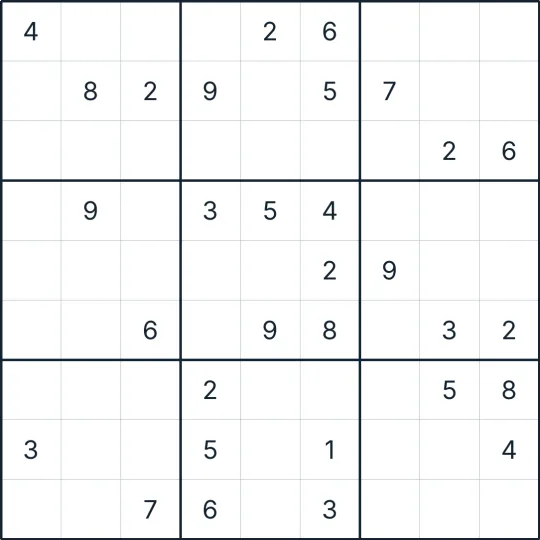
See the rule in action
Every row, column and 3 × 3 box contains 1–9 once. Start with a cell whose options you can prove.
Three groups. One rule.
A classic board has 81 cells arranged in nine rows and nine columns. Thicker lines divide it into nine 3×3 boxes. Every row, column and box must contain the numbers 1 through 9 exactly once.
The starting numbers are called givens. Keep them unchanged. A completed row is not enough on its own: each entry must also fit its column and box.
Work through a first move
Imagine a row containing 1, 2, 3, 4, 5, 6, 8 and 9, with one empty cell. The missing number is 7. Check that 7 fits the cell’s column and box, then place it.
When a group has several empty cells, use the crossing rows and columns to eliminate possibilities. You are looking for a number that must fit, not one that merely looks plausible.
Use notes for unfinished thoughts
Small candidate notes record numbers that could still occupy a cell. A cell with notes 2 and 6 is not solved yet. Later clues may rule out one option. Remove notes as soon as new entries make them impossible.
Your first game
- Open an easy puzzle.
- Scan the most complete rows, columns and boxes.
- Place only numbers you can justify.
- Recheck nearby cells after each placement.
- Use a hint when you want an example of the next logical step.
A few useful answers
Do diagonal lines have to contain 1–9 too?
Not in classic sudoku. That additional rule belongs to diagonal sudoku, where the two main diagonals are marked.
Can a number repeat in a different box?
Yes. Every digit appears nine times in a completed classic board, once in each row, column and box.