
Games like sudoku: choose your next puzzle
Looking for games like sudoku? These five variants keep number-placement logic while changing the clues, regions or size of the board. Compare what changes and choose a game you can play here for free.
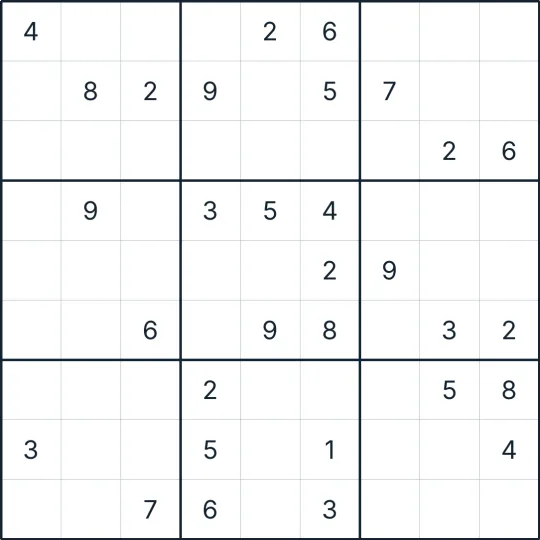
See the rule in action
Every row, column and 3 × 3 box contains 1–9 once. Start with a cell whose options you can prove.
Killer sudoku: add cage sums
Choose killer sudoku if you want number placement with arithmetic. The usual rows, columns and boxes still contain 1–9. Dotted cages add a total, and a digit cannot repeat inside a cage. A two-cell cage totaling 3 therefore contains 1 and 2.
The challenge is to combine possible sums with position restrictions. A valid sum is not enough if its digits conflict with the row, column or box.
Diagonal sudoku: follow two extra groups
Diagonal sudoku, also called Sudoku X, adds the two main diagonals to the ordinary 9×9 rules. Each marked diagonal contains 1–9 once. The center cell belongs to both diagonals, so it has two additional sets of restrictions.
Try this when you want familiar square boxes with an extra way to find hidden singles. Short, unmarked diagonal lines have no special rule.
Jigsaw sudoku: change the region shapes
Jigsaw or irregular sudoku replaces square 3×3 boxes with nine outlined regions of nine cells each. Rows and columns stay the same. Trace the entire region before ruling out a candidate; neighboring cells may lie on opposite sides of its boundary.
This suits players who enjoy scanning patterns but want to break the habit of looking only at square boxes.
Mini sudoku: make the board smaller
A 4×4 board uses 1–4 and 2×2 boxes. A 6×6 board uses 1–6 and 2×3 boxes. Each is a complete puzzle with its own solution, not a cropped section of a larger grid.
Choose mini sudoku for a shorter number list, a first lesson or practice with children. Explain each placement using the row, column and box before moving to a full 9×9 puzzle.
Samurai sudoku: connect five grids
Samurai sudoku links five classic grids through shared 3×3 boxes. An overlapping cell has one value that must satisfy both grids. A deduction in an outside grid can therefore unlock the center.
Choose samurai when you want a larger connected puzzle and enjoy switching between local problems. Use the individual-grid focus controls on a small screen, or print the complete layout.
Does math sudoku use different rules?
Classic sudoku uses digits as symbols: you do not add or multiply them. If you want addition within a sudoku grid, killer sudoku combines cage totals with classic rows, columns and boxes. A row contains 1–9 once, so its total is 45; complete cages contained within that row can help you work out the remaining cells.
Math sudoku is a broad label. Some arithmetic puzzles use multiplication, subtraction or division clues and different region rules. Read the displayed rules before playing: the killer game linked here uses addition cages, and the classic solver does not check those extra cage constraints.
A few useful answers
Which sudoku variant should a beginner try?
Start with a 4×4 mini sudoku to practice the no-repeat rule with four digits. If you already know classic sudoku, try diagonal sudoku and check the two marked diagonals as extra groups.
Do all sudoku variants use arithmetic?
No. Classic, mini, diagonal, jigsaw and samurai sudoku use placement and elimination. Killer sudoku adds arithmetic because the digits in each cage must match a total.