
Stuck on sudoku? Change what you look for.
Stuck on sudoku? These sudoku solving strategies help you find a next move you can explain. Work through singles, locked candidates and pairs, then practice the same deductions on a playable grid.
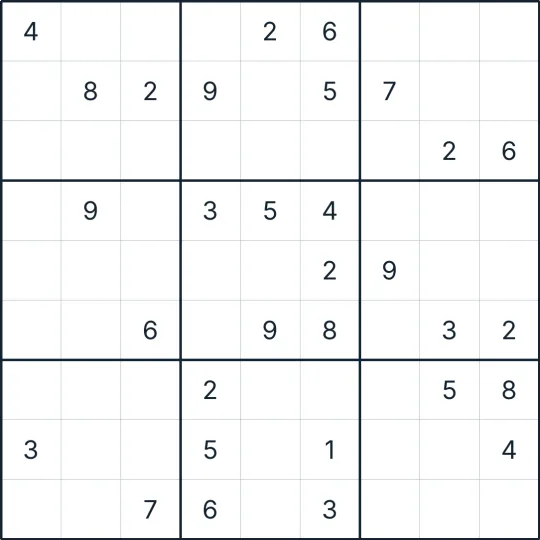
See the rule in action
Every row, column and 3 × 3 box contains 1–9 once. Start with a cell whose options you can prove.
1. Look for a single possibility
A naked single is a cell with only one legal candidate. A hidden single is a number with only one available position in a row, column or box, even when that cell has other notes. Check both before trying more complicated techniques.
2. Follow a locked candidate
If all possible positions for 5 inside a box lie on the same row, that row must contain its 5 inside the box. Remove 5 from the row’s cells outside the box. This gives useful information without placing the 5 yet.
3. Spot a naked pair
Two cells in the same group, each containing only 2 and 9, reserve those two numbers between them. Remove 2 and 9 from the other cells in that group. The pair does not work if one of those two cells has an additional candidate.
4. Turn each elimination into a fresh scan
After removing a candidate, check the affected cells and groups for singles. Advanced patterns often matter because they uncover a simple placement. You do not need to keep searching for the hardest move available.
Give yourself a useful target
Instead of trying to solve sudoku in one minute, aim to explain your next move. Speed varies with experience and the particular puzzle. A short pause, a note cleanup or a single explained hint can be more useful than rushing.
Practice solving sudoku step by step
Use an easy grid to practice singles: find a nearly full row, list its missing digits, then eliminate digits already present in each empty cell’s column and box. Explain why the remaining digit is forced before entering it.
Move to a medium puzzle to practice locked candidates. If all the places for 5 in a box are on one row, remove 5 from that row outside the box. Recheck for singles after the elimination. On a hard puzzle, look for a naked pair before moving to more complicated patterns.
This is a self-guided practice sequence. Keep notes of the technique behind a move, not just your finishing time; no method guarantees that every puzzle can be solved in one minute.
Practice singles in easy sudoku · Practice candidates in medium sudoku · Practice pairs in hard sudoku · Check an entered puzzle with the sudoku solver
A few useful answers
Why did a hint remove a note instead of placing a number?
Eliminations narrow the grid. Removing one impossible candidate can expose a definite placement elsewhere.
What if none of these techniques works?
A harder puzzle may need a different pattern. Check your notes, use the next-step hint, or try the expert guide’s X-wing example.